

The 2025 Nobel Prize in Physics honored experiments that made quantum effects tunneling and discrete energy levels directly observable in macroscopic superconducting circuits built from Josephson junctions.

Figure 1: Diagram of a Josephson Junction (two superconductors separated by a thin insulator).
Those same tools underpin today’s superconducting qubits, quantum-limited microwave amplifiers, and ultra-sensitive SQUID sensors. Below, I connect the prize-winning science to concrete research frontiers and industry use cases and list the gaps that targeted R&D must close each paragraph backed by primary sources.
Nobel Prize press release (2025),
APS Physics explainer.
What the Nobel Recognized
The Royal Swedish Academy of Sciences awarded the 2025 Nobel Prize in Physics to John Clarke, Michel Devoret, and John Martinis “for experiments demonstrating macroscopic quantum tunneling and energy quantization in an electrical circuit,” with the official description and dates published on 7 Oct 2025.
Nobel Prize press release,
Nobel popular information.
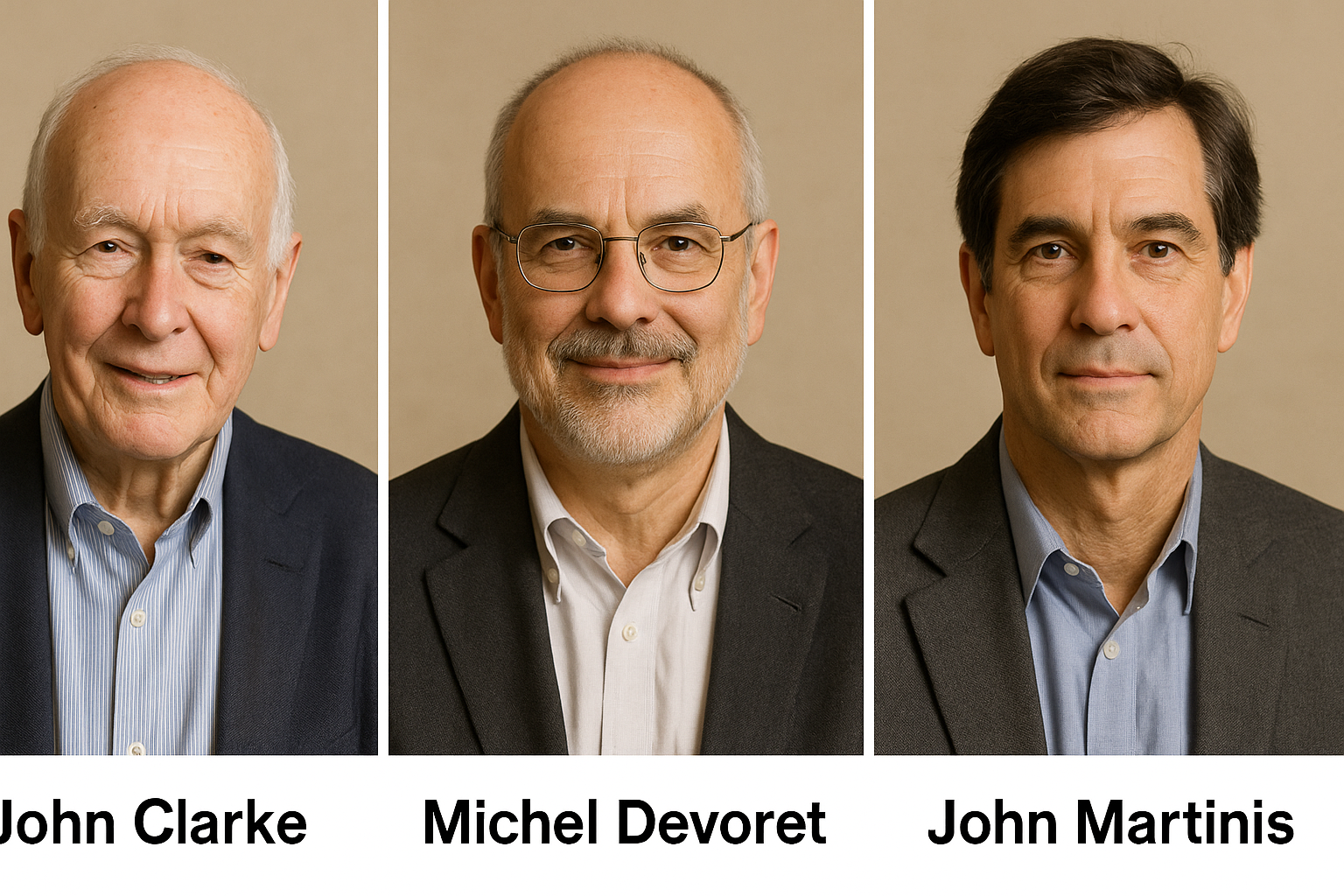
Technical explainers from the American Physical Society summarize how the laureates used superconducting circuits (Josephson junctions) to directly observe macroscopic quantum tunneling and discrete energy levels, laying foundations later used for superconducting qubits.
APS Physics: “Nobel Prize: Quantum Tunneling on a Large Scale”,
Washington Post coverage.
The prize builds on earlier pillars: Brian Josephson’s 1962 prediction that a supercurrent can pass across an insulator between superconductors (the Josephson effect), and Anthony Leggett’s framework on dissipation/decoherence controlling macroscopic quantum behavior.
Josephson (Physics Letters, 1962),
Caldeira & Leggett (PRL, 1981).
Why This Matters: A Unifying Toolkit
Superconducting circuits enable three cross-cutting capabilities with broad translational impact: (1) macroscopic quantum coherence for qubits, (2) quantum-limited microwave amplification (e.g., JPAs/JTWPAs) for readout and sensing, and (3) ultra-sensitive magnetic sensing via SQUIDs—now central to quantum computing, axion searches, radio astronomy readouts, biomedical MEG, geophysics, and NDE.
APS Physics explainer (2025),
Macklin et al., Nat. Phys. (2015) TWPA,
Faley et al., SQUID NDE review (2017).
Industry Use Cases & Research Directions
1) Quantum Computing & Cloud
State of play. Superconducting qubits stem directly from Josephson physics; the Nobel materials explicitly connect the laureates’ macroscopic tunneling/quantization results to today’s quantum technology trajectory.
Nobel popular information,
APS Physics explainer.
Key enabler quantum-limited amplification. Josephson parametric amplifiers (JPAs) and traveling-wave parametric amplifiers (TWPAs) provide near-quantum-noise readout with wide bandwidth for multiplexed qubits; recent work documents performance, dynamic range, and deployment trade-offs.
TWPA: Macklin et al., Nat. Phys. (2015),
RF amplifiers for QC review (2025).
Gap → research need. Intermodulation distortion and gain compression in JTWPAs degrade multiplexed readout fidelity; controlled characterization and mitigation are required for large-scale processors.
Remm et al., Phys. Rev. Applied (2023),
Kaufman et al., arXiv (2023).
Strategic outlook. Government roadmaps emphasize improved error correction, cryo-electronics integration, packaging, and interconnects to move from NISQ to fault-tolerant systems.
U.S. DOE QIS Applications Roadmap (2024),
EU Quantum Flagship SRIA 2030.
2) Biomedical: Brain & Nerve Mapping (MEG/MNG)
State of play. SQUID-based magnetoencephalography (MEG) measures femto- to picotesla neural fields with millisecond resolution; current reviews and tutorials detail clinical/research use and hardware limits.
Gutteling et al., 2025 (PMC),
Brookes et al., Trends in Neurosciences (2022).
What’s new. Wearable OPM-MEG reduces motion constraints and shows comparable source localization to SQUID-MEG in real-world studies, broadening clinical access.
Pedersen et al., Epilepsia (2022),
Ren et al., NeuroImage (2025).
Gap → research need. Classic SQUID-MEG struggles with deep sources and motion; OPM-MEG mitigates motion but introduces calibration and interference challenges motivating hybrid systems and improved inverse modeling.
Brickwedde et al., Mol. Psychiatry (2024),
Gutteling et al., 2025.
3) Exploration Geophysics & Energy
State of play. SQUID receivers are used in airborne and fixed-loop EM surveying, enabling deeper targets and slower-decay responses than conventional coils in conductive terrains.
Lee et al., Geophysics (2002),
Wu et al., J. Geophys. Eng. (2022).
Gap → research need. Platform motion noise and dynamics limit airborne performance; recent reports recommend noise-reduction strategies and better 3D inversion for conductivity structures.
Larnier et al., SQUID natural-field EM (2021, PDF),
Stolz et al., Surv. Geophys. (2022).
4) Nondestructive Evaluation (NDE) & Advanced Manufacturing
State of play. SQUID-based systems detect subtle magnetic/electromagnetic signatures for NDE of metals/composites; comprehensive instrumentation reviews and demonstrations exist.
Faley et al., SQUID NDE review (2017, PMC),
Shinyama et al., HTS-SQUID CFRP defect detection (2011).
Gap → research need. Industrial deployment needs ruggedization, EMI suppression, and standardized procedures for in-situ inspections.
Faley et al., 2017 (PMC).
5) Fundamental Physics, Radio Astronomy & Dark Matter
State of play. JPAs/JTWPAs are standard in ultra-weak microwave detection (e.g., axion haloscopes). Squeezed-state receivers demonstrably enhance scan rates in recent HAYSTAC results.
HAYSTAC Phase II, PRL (2025),
Semertzidis & Youn, Sci. Adv. review (2022).
Gap → research need. Quantum enhancements (e.g., squeezing) face loss-imposed limits; new control protocols and hardware aim to maintain advantage in realistic, lossy environments.
HAYSTAC Phase II, PRL (2025),
Palken (JILA) thesis on squeezing (2024, PDF).
6) Defense, Navigation & Quantum Sensing
State of play. Broad surveys outline quantum inertial, gravitational, and magnetometric sensors.including SQUID-based and atom-based devices.progressing from lab prototypes to packaged systems.
U.S. DOE QIS overview,
EU Quantum Flagship SRIA.
Gap → research need. Transition-to-product challenges include calibration, SWaP at cryogenic stages, and robustness in contested EM environments—highlighted in current roadmaps and policy updates.
DOE QIS Applications Roadmap (2024),
Reuters on EU Quantum Strategy & funding (2025).
Cross-Cutting Gaps Blocking Scale-Up
Decoherence & dissipation. Foundational theory shows environmental damping suppresses macroscopic quantum behavior; device design must minimize dissipation and dephasing.
Caldeira & Leggett (PRL, 1981).
Cryogenics & materials. Reviews of superconducting quantum tech highlight fabrication uniformity, cryo-CMOS control, and packaging as bottlenecks to scaling processors and sensor arrays.
APS Physics explainer (2025),
DOE QIS Roadmap (2024).
Readout & interconnects. Amplifier nonlinearity (intermodulation, gain compression) limits multiplexing density and throughput in both quantum computers and sensor arrays, requiring device/system-level mitigation.
Remm et al., Phys. Rev. Applied (2023),
Le Gal et al., gain compression in JTWPAs (2025).
Standards & roadmaps. Government and regional strategies call for common benchmarks, application-relevant error metrics, and end-to-end stacks to accelerate transition from demos to mission impact.
DOE QIS Roadmap (2024),
EU Quantum Flagship SRIA 2030.
What to Build Next (Actionable R&D Themes)
- Noise-robust quantum readout chains—JTWPAs/JPAs with calibrated linearity, digital predistortion, and cryo-CMOS multiplexing for high-fidelity, high-throughput readout.
Macklin et al., Nat. Phys. (2015),
Remm et al., 2023. - Hybrid neuroimaging—combine SQUID-MEG with wearable OPM arrays plus advanced inverse solvers for motion-tolerant clinical studies.
Brookes et al., 2022,
Gutteling et al., 2025. - Low-noise airborne geophysics—platform motion-noise suppression plus improved 3D EM inversion workflows for deep targets.
Lee et al., 2002,
Larnier et al., 2021. - Dark-matter & radio-astronomy receivers—use squeezing and optimized JPAs to beat scan-rate limits under loss.
HAYSTAC Phase II, PRL (2025),
Semertzidis & Youn, 2022. - Rugged SQUID-NDE toolkits—EMI-hardening and industrial calibration standards for aerospace/energy assets.
Faley et al., 2017.
Bottom Line
The laureates showed that “quantum works on a chip,” transforming an abstract principle into an engineering toolbox for computing, sensing, imaging, and exploration. Near-term progress hinges on taming loss and nonlinearity, integrating cryo-electronics, and standardizing system metrics—priorities echoed across official Nobel materials, technical explainers, and government roadmaps.
Nobel press release (2025),
APS Physics explainer,
DOE QIS Roadmap (2024).
Source of Inspiration
Background context and narrative framing were inspired by the newspaper article, The curious history of how quantum mechanics came to be ‘seen’ in an electrical circuit (The Hindu, Text & Context, Oct 11, 2024).
The Hindu (article link).
 The Blog of Dr. Saurabh Katiyar